Open Weights, Explained Without the Hype
What open weights are and how close they sit to the best. Plus the cheap ways to use them.
Part 1 drew a map with three layers: access, harness, model.
This part is about the model layer, the half of it that nobody sells you in an app.
There are models you can download. Whole. For free.
People get this wrong in two directions.
Some think open models are toys. The best one now scores above Claude Haiku 5.5, a model people pay for.
Others think open means free of rules and as good as the best. The licence often has conditions. The best closed model is still clearly ahead.
This part explains what "open" means, where to find the models, how far behind they are and how to use one for cents without owning any hardware.
I read the licence files, the documentation, the leaderboards and the price lists on 13 and 14 November 2026. Every figure carries its date.
1. What "open" means
A model is a very large file of numbers. Those numbers are called weights.
Open weights means the lab published that file. Anyone can download it and run it on their own computer or rent a server that does.
Closed means the file never leaves the lab. You reach the model through their app or their API. Claude, GPT and Gemini work this way.
Open source is a stricter word. The Open Source Initiative published a definition for AI in version 1.0. It asks for four freedoms: to use, study, modify and share the system. To qualify, a lab has to release the weights, the full code and enough information about the training data [1].
Almost no large model meets that bar. Most are open weights only. You get the file. You do not get the recipe.
For a user that is usually enough. What matters to you is the licence on the file.
Licences come in three kinds.
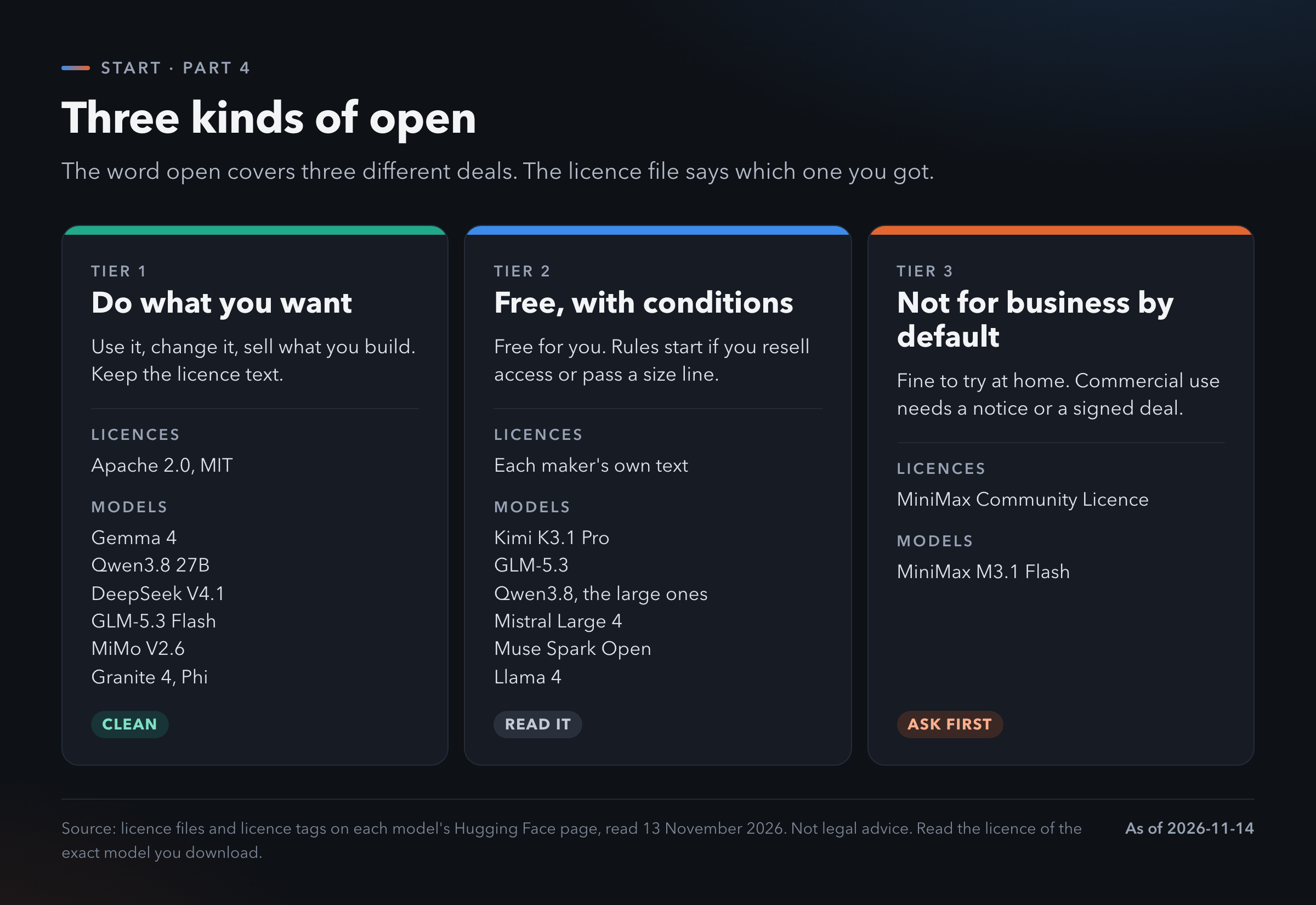
Tier 1: do what you want. Apache 2.0 and MIT are the two standard licences. Apache 2.0 is perpetual, worldwide, royalty-free and irrevocable. It includes a patent grant. You keep the licence text and mark your changes [2]. Gemma 4, Qwen3.8 27B, DeepSeek V4.1, MiMo V2.6, Granite and Phi sit here.
Tier 2: free, with conditions. The lab wrote its own licence. It reads like MIT with extra clauses.
Kimi K3.1 Pro is the clearest case. Anyone can use it. A business that resells access to it and earns over 20 million dollars in a year needs an agreement with Moonshot. A product with over 100 million monthly users has to show the name "Kimi K3.1 Pro". Internal use is exempt [3].
GLM-5.3, the large Qwen models, Mistral Large 4, Llama 4 and Meta's Muse Spark Open follow the same pattern with different numbers [3] [4].
Tier 3: not for business by default. MiniMax M3.1 Flash ships under a community licence. Commercial use needs attribution and a notice. Above 20 million dollars of yearly revenue it needs written permission [3].
What this means for you. Personal use is fine under every licence in the figure. So is use inside your own company.
The conditions bite in three cases: you resell access to the model, you ship a product with the model inside, or your company passes a revenue line.
If none of those is you, pick on quality and price. If one is, read the licence file before you build. It is a short text file in the model's repository.
2. Hugging Face, the place they live
Hugging Face is where labs publish models. Think of it as a public library for model files.
The numbers are large. Over 3 million models, 1 million datasets and 2 million apps [5].
Each model has a page. The page is the label on the tin.
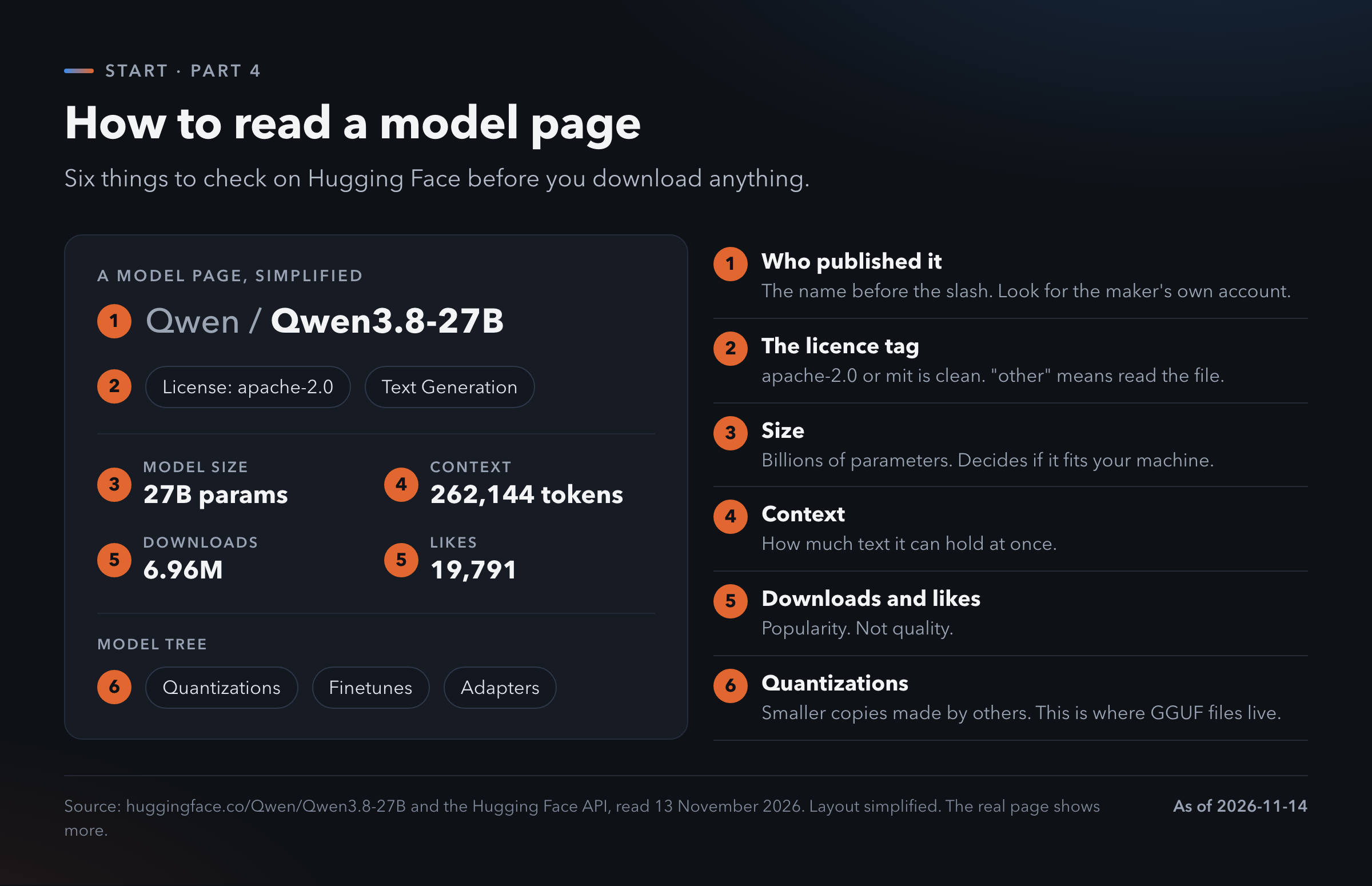
Read six things.
Who published it. The name before the slash. Qwen/ is Alibaba's own account. Anything else is a copy somebody made.
The licence tag. apache-2.0 and mit are tier 1. A tag that says other means the lab wrote its own. Open the licence file.
The size. Counted in parameters. 27B is 27 billion. Bigger is usually smarter and always heavier.
The context. How much text the model can hold at once. Qwen3.8 27B takes 262,144 tokens [6].
Downloads and likes. Popularity. Qwen3.8 27B had 6.96 million downloads and 19,791 likes on the day I looked [6]. Popular is a sign that the files work. It says nothing on quality.
Quantizations. A link to smaller copies of the same model, compressed so they fit a home machine. Part 6 covers those.
One trap with size. Some large models only switch on part of themselves for each word. The page lists the total. Mistral Large 4 has about 1 trillion parameters and uses 52 billion at a time. The total decides how much memory you need.
GGUF. You will see these four letters on every compressed copy. It is a file format made by the author of llama.cpp. One file holds the whole model. It runs in llama.cpp, LM Studio, GPT4All and Ollama [7].
The trending page is a popularity chart. On 13 November the top model was a community repack with "UNCENSORED" in its name [8]. A repack is a modified copy from an account you do not know. It carries no test results from the lab.
Download from the lab's own account or from a well-known packager. Skip the rest until you know why you want them.
Some downloads are gated. The page asks you to accept terms first. Meta's Muse Spark Open asks for your name, date of birth and organization before it lets you in.
3. The families
Twelve families matter in November 2026.
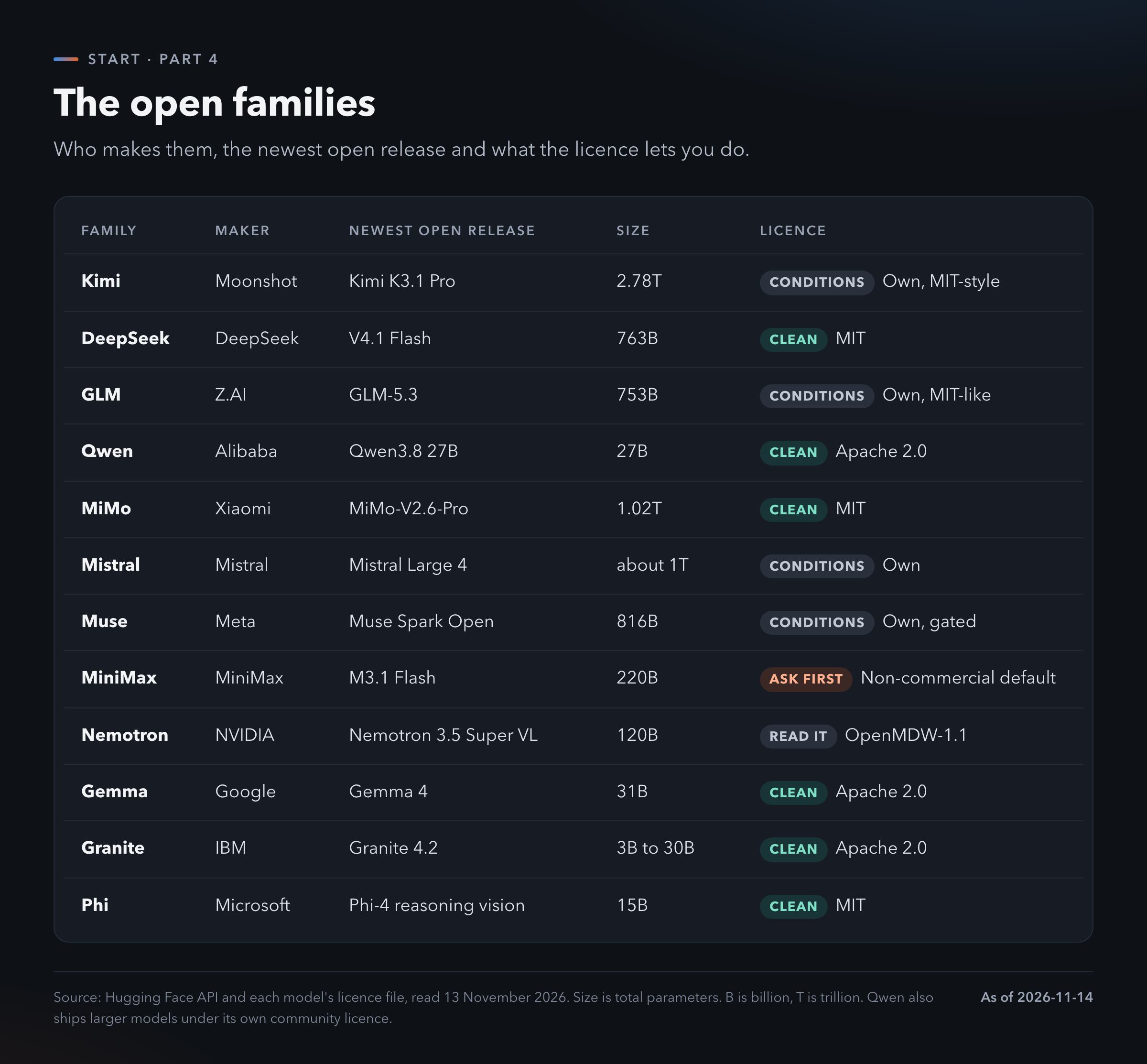
The big ones come from China. Kimi from Moonshot, DeepSeek, GLM from Z.AI, Qwen from Alibaba, MiMo from Xiaomi and MiniMax. Kimi K3.1 Pro is the largest at 2.78 trillion parameters. It came out on 2 November.
The Western labs ship smaller. Google's Gemma 4 tops out at 31 billion. IBM's Granite runs from 3 to 30 billion. Microsoft's Phi sits at 15 billion. All three carry clean licences.
Mistral and Meta are the exceptions on size. Mistral Large 4 is about 1 trillion. Muse Spark Open is 816 billion. Both come with their own licences.
Size tells you where it can run. Anything measured in hundreds of billions needs a rack of server hardware. You will rent it by the token. Section 5 shows how.
The models at 31 billion and under fit a good home machine. Part 6 covers that.
Read the model name, not the family name. Qwen3.8 27B is Apache 2.0. The 2.4 trillion Qwen3.8 has a community licence. Qwen3.8 Max is closed and API only. Same family, three different deals.
4. Open against closed
Now the question everyone asks. How good are they?
I use the Artificial Analysis Intelligence Index. It blends several tests into one score. Higher is better [9].
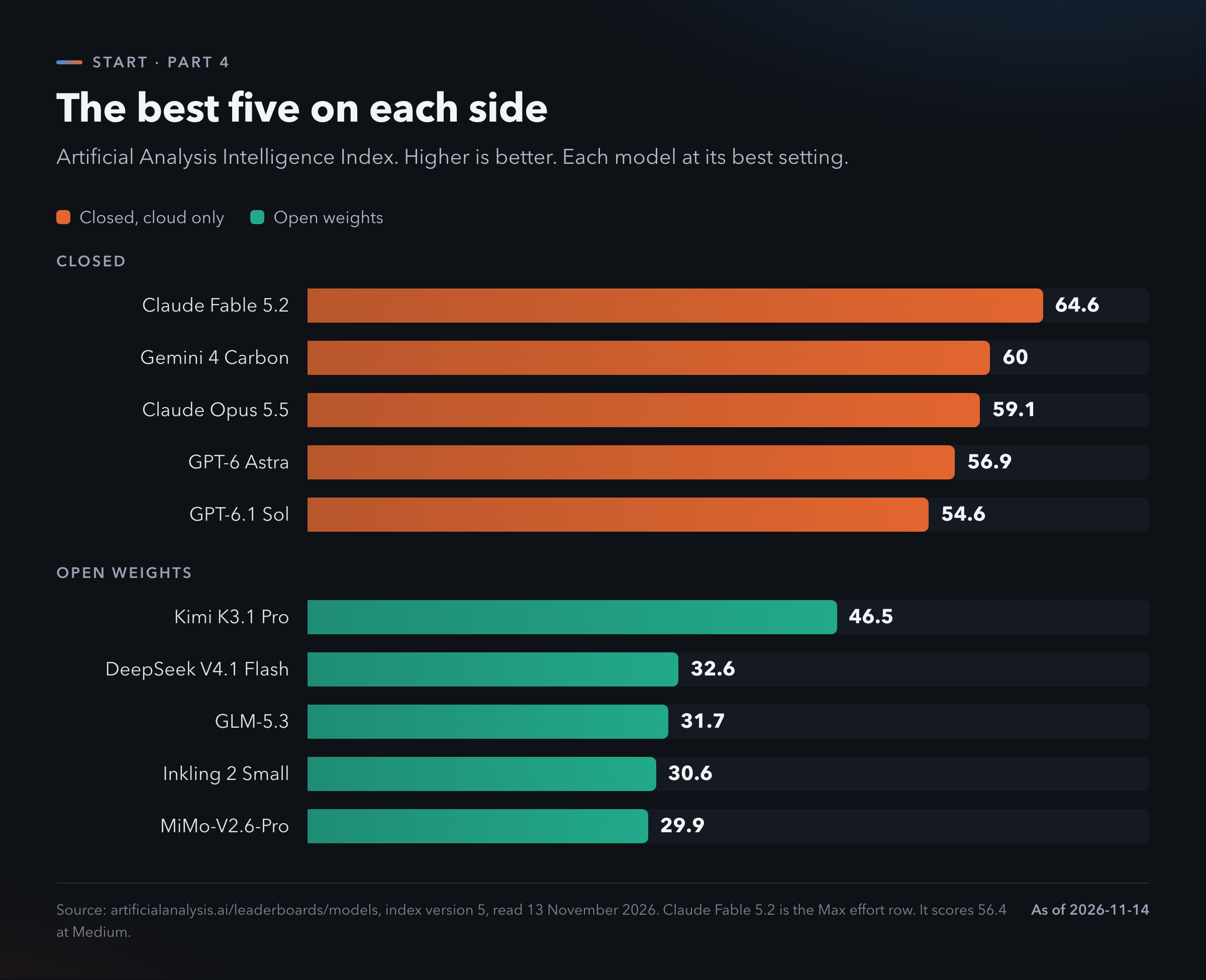
The best closed model scores 64.6. That is Claude Fable 5.2 at its highest setting.
The best open model scores 46.5. That is Kimi K3.1 Pro.
The gap at the top is 18.1 points.
One model does most of the work on the open side. Second place among open models is DeepSeek V4.1 Flash at 32.6. Compare fifth against fifth and the gap is 24.7 points.
So the honest summary has two halves. The best open model is strong. The open field behind it is a full tier below.
The gap depends on the test.
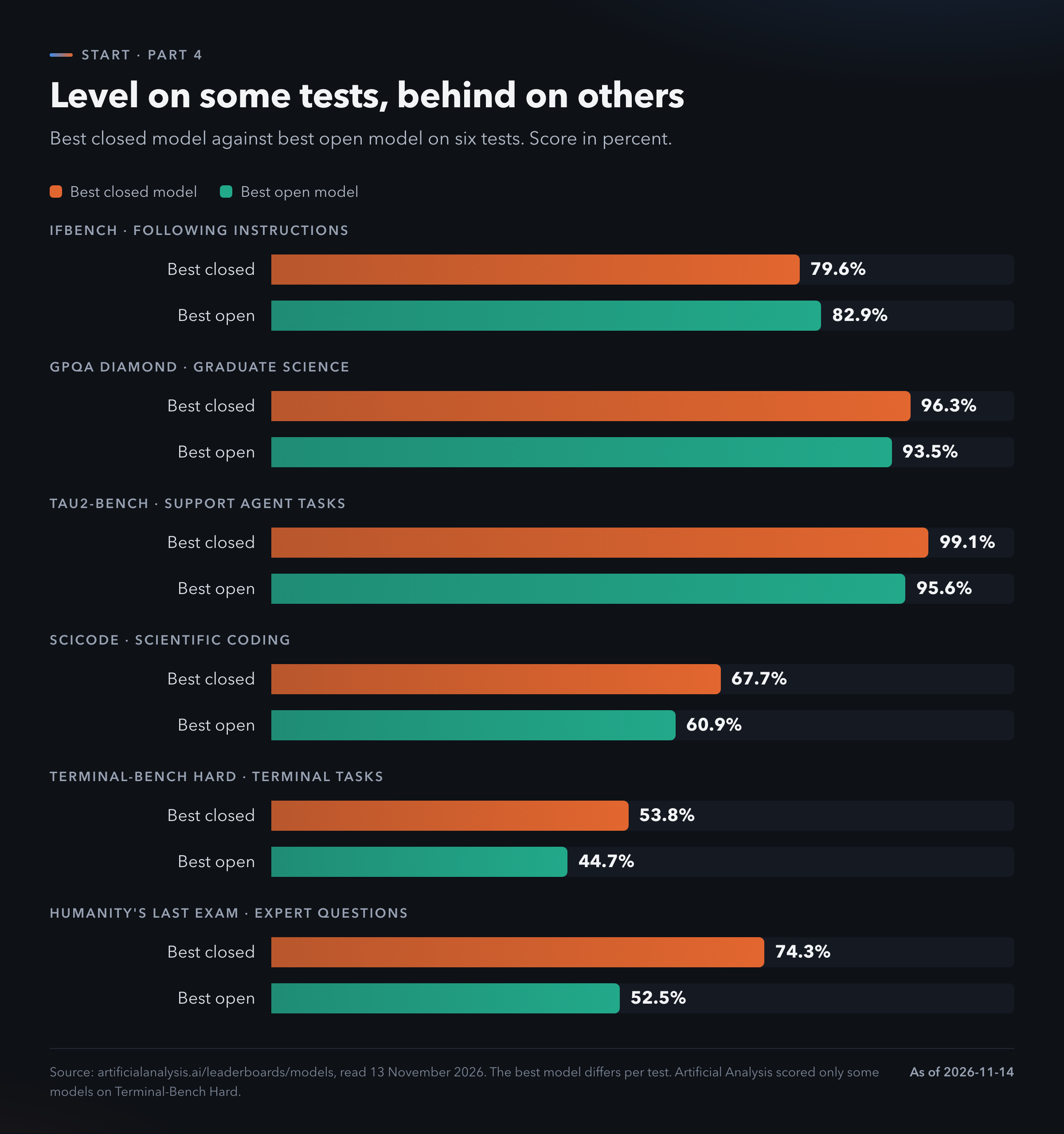
On following instructions, the best open model is ahead: 82.9 against 79.6.
On graduate science questions and on support-agent tasks, open trails by about 3 points.
On scientific coding the gap is 7 points. On hard terminal tasks it is 9.
On Humanity's Last Exam, a set of expert questions, it is 22 points: 74.3 against 52.5.
The pattern. Open models are level on well-defined work. Follow these rules. Answer this known kind of question. Handle this support ticket.
They fall behind where the problem is long, new or hard. That is also where an agent spends most of its time.
Two other measures agree.
On Arena, people vote blind between two answers. The top 15 text models were all closed on 11 November. The best open model, Kimi K3, sat at rank 20 [10].
Epoch AI measured the lag in time. In May 2026 it found open models about four months behind closed ones [11]. That study predates Kimi K3.1 Pro.
Four months is short.
Now add price.
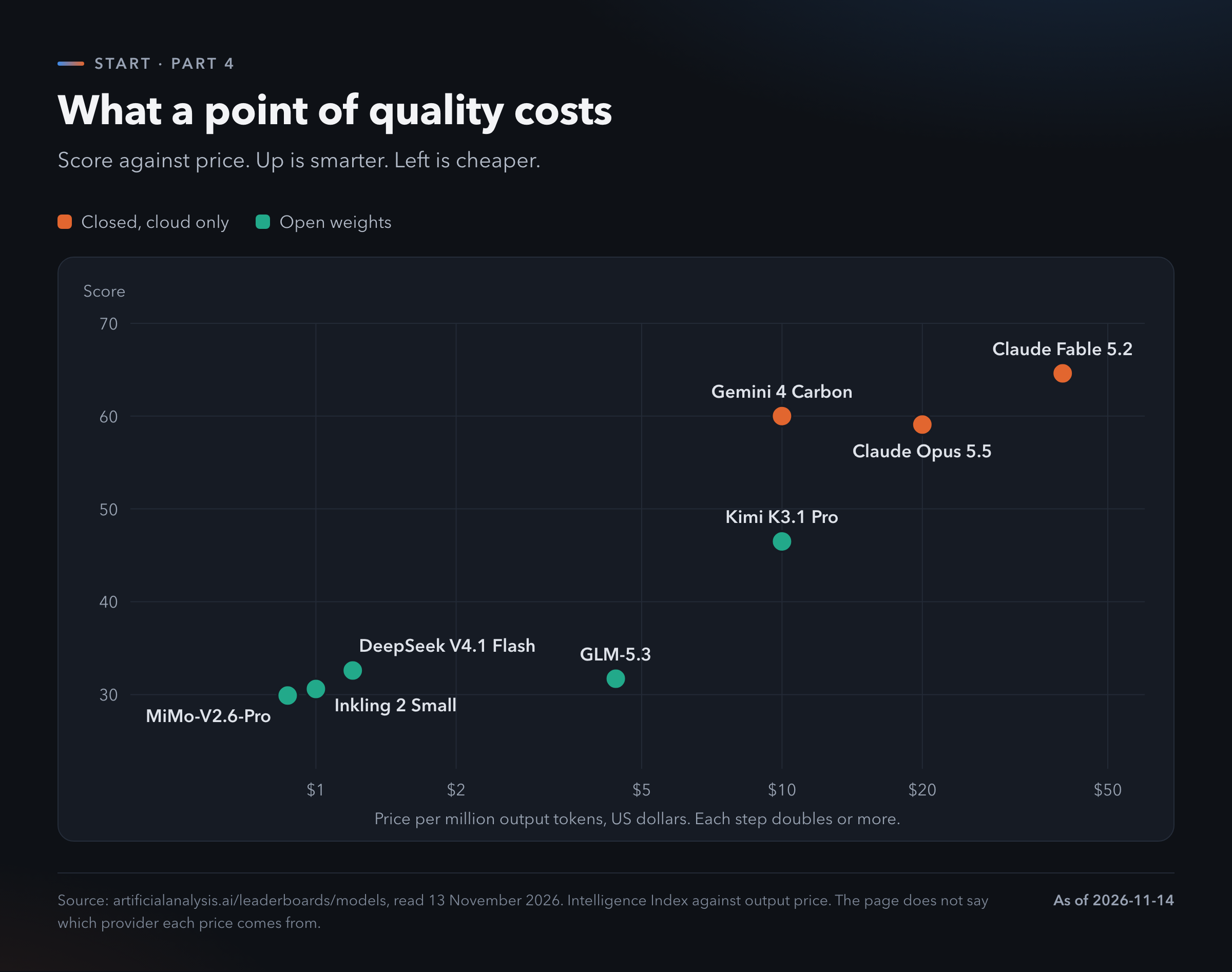
Claude Fable 5.2 costs 40 dollars per million output tokens. DeepSeek V4.1 Flash costs 1.20.
That is 33 times cheaper for half the score.
Half the score sounds bad. For sorting email, pulling fields out of invoices or writing a first summary, it is plenty. Those jobs do not need the best model in the world. They need a decent one that runs ten thousand times without a bill you notice.
Open does not always mean cheap. Kimi K3.1 Pro costs 10 dollars per million output tokens. Gemini 4 Carbon costs the same and scores 13.5 points higher.
A model with 2.78 trillion parameters is expensive to run, whoever owns the file.
The bargains are the small and mid-sized open models. Look at the bottom left of the figure.
5. OpenRouter, step by step
You do not need hardware to use an open model. Companies run them on their servers and sell you access by the token.
There are dozens of such providers. OpenRouter puts them behind one door.
One account and one key reach more than 600 models from more than 80 providers [12]. Closed models are in there too.
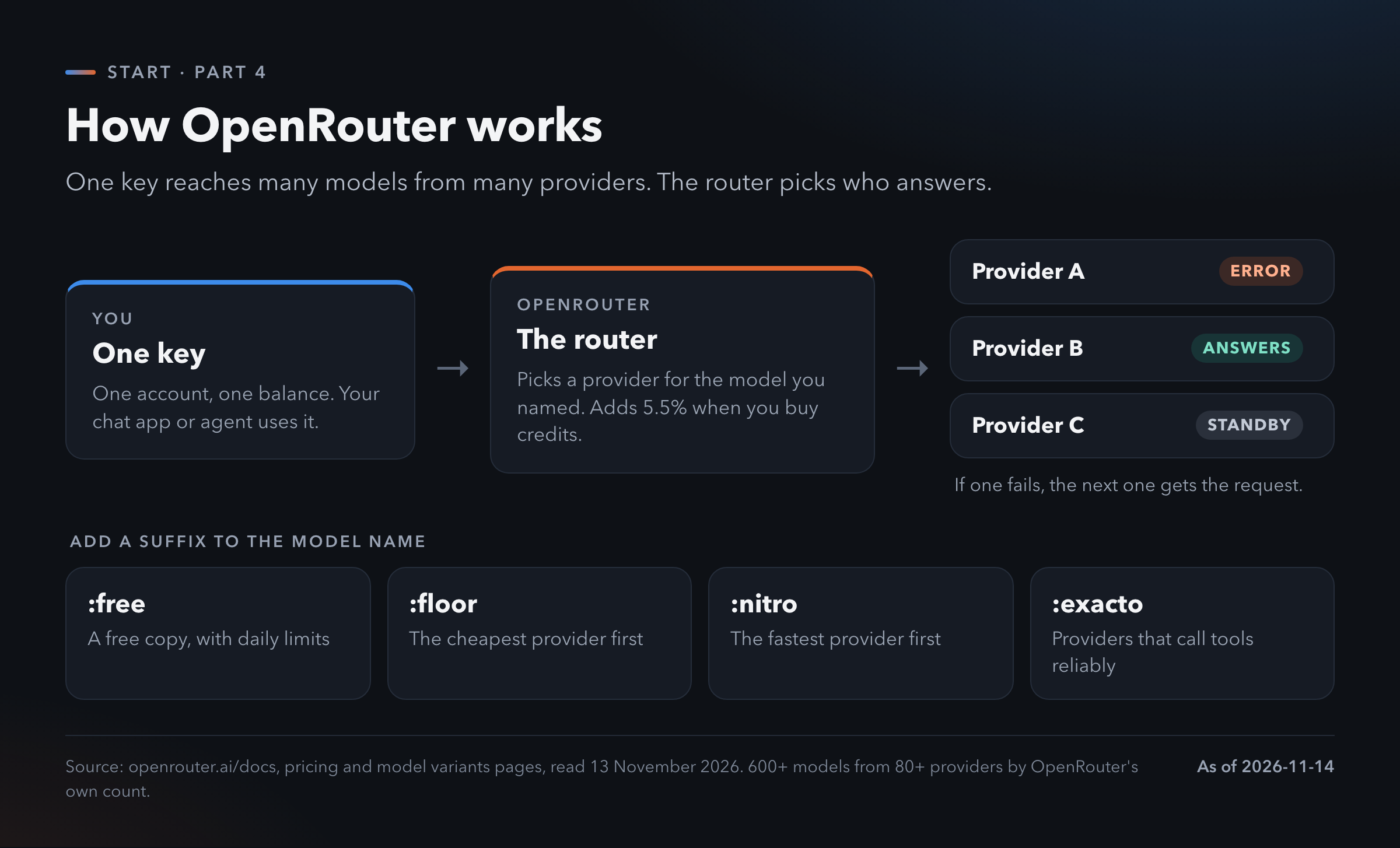
How it works. You send a request to OpenRouter. It picks a provider that hosts the model. If that provider fails, it tries the next one. You get one answer and one bill.
What it costs. OpenRouter adds 5.5% when you buy credits, with a minimum fee of 0.80 dollars [12]. The token prices are the providers' own.
Getting started takes five steps.
- Make an account at openrouter.ai.
- Buy a small amount of credits. Ten dollars goes a long way with the models in this part.
- Create an API key. Set a spending limit on the key itself.
- Pick a model from the list. Each one has an ID in the form
lab/model-name. Copy it from the page. Do not type it from memory. - Paste the key and the ID into your tool. Most tools from Part 3 accept an OpenAI-style address. For OpenRouter that address is
https://openrouter.ai/api/v1.
Four endings change what you get. You add them to the model ID.
:freeuses a free copy of the model, with limits.:floorpicks the cheapest provider.:nitropicks the fastest provider.:exactopicks providers that handle tool calls reliably. Use it for agents.
The free tier is for trying, not for working. Free models allow 20 requests a minute and 50 a day. Buy 10 credits once and the daily limit goes to 1,000 [12].
Keep the balance above zero. A negative balance blocks the free models too.
Privacy has two layers. OpenRouter does not store your prompts or answers by default. It stores metadata, such as which model you called and how many tokens you used [13].
Each provider behind it has its own policy. Some keep nothing. Some keep data for a while. Some train on it.
OpenRouter skips providers that train on your data unless you switch that on yourself [13]. Leave that setting off.
What people use it for.
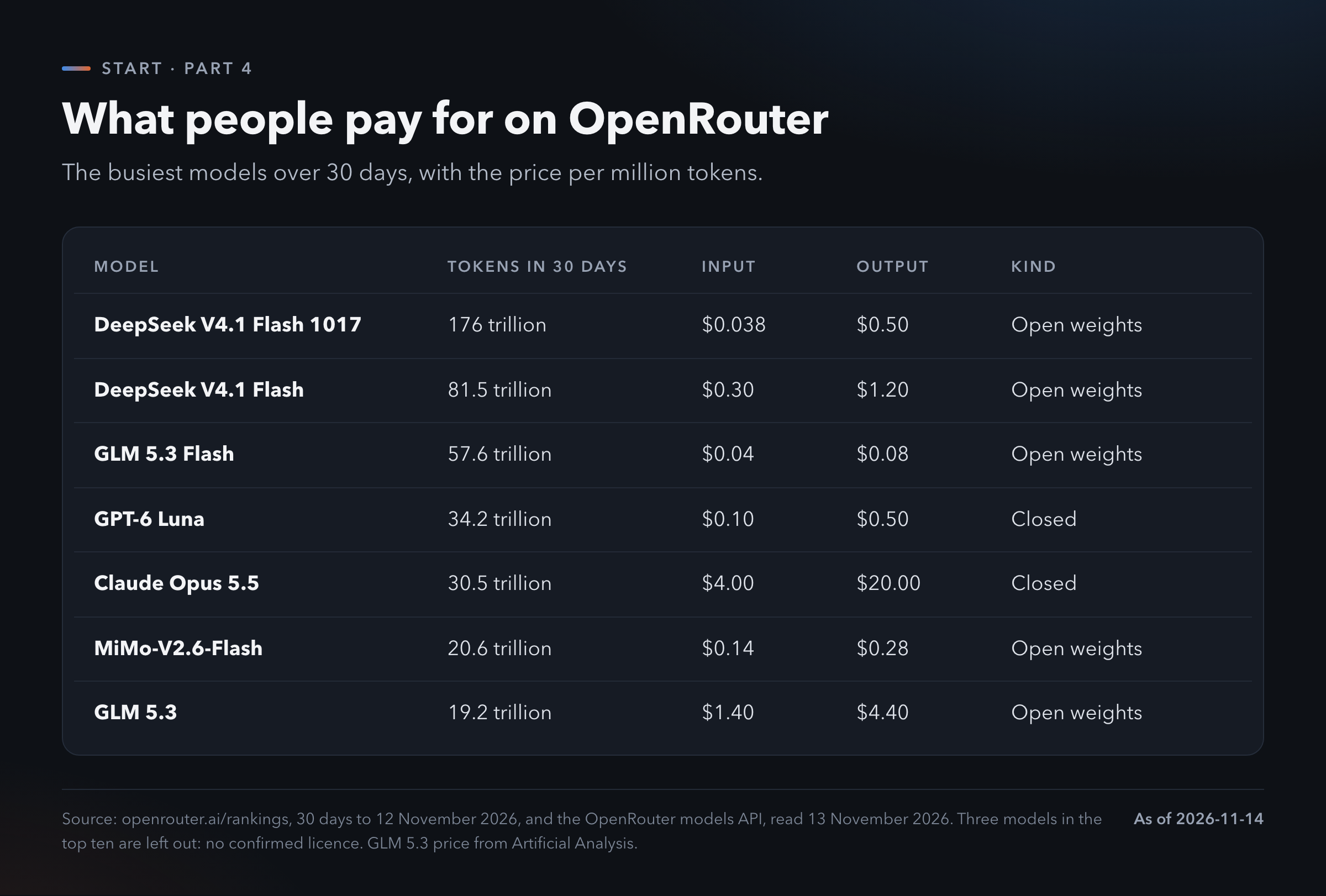
Five of the seven models in the figure are open weights [19].
The most used one, a DeepSeek V4.1 Flash release, moved 176 trillion tokens in 30 days. It costs 0.50 dollars per million output tokens.
Claude Opus 5.5 is on the list too, at 20 dollars.
People use both. Cheap open models carry the volume. An expensive closed one handles the hard part.
That split is the practical lesson of this whole part.
6. Other routes
OpenRouter is the easy door. There are others.
The lab's own API. DeepSeek sells its models directly. deepseek-flash costs 0.30 dollars per million input tokens and 1.20 for output, with half price off-peak [14].
Read the privacy policy first. It says your data is stored in China and can be used for training. There is an opt-out [14].
Hugging Face Inference Providers. The model page has a panel that runs the model for you. Over 200 models, billed at the provider's price with no markup [15].
Fast hosts. Groq and Cerebras run open models on their own chips and sell speed. Cerebras gives a 5 dollar trial credit that lasts 30 days [16].
Gateways for builders. Vercel AI Gateway does a similar job to OpenRouter and adds no markup on tokens [17]. LiteLLM is a free router you run yourself under an MIT licence [17].
Your own machine. The small models run at home. That is Part 6.
One route closed. GitHub Models shut down on 30 July 2026. Old guides still point to it.
7. What to watch for
Scores on a model page are the lab's own. Nobody checked them. Use an independent board.
Boards can be gamed too. A 2025 paper called "The Leaderboard Illusion" found that labs tested many private variants on Arena and published only the best. One lab tested 27 [18].
Read two boards. Trust the model that does well on both.
The provider matters. The same open model is hosted by many companies. They do not all behave the same. OpenRouter has the :exacto ending because providers differ in how well they handle tool calls.
If an agent starts failing on tool calls, try :exacto or a different provider before you blame the model.
The licence can change with the next release. Qwen3.8 27B is Apache 2.0. Nothing promises the next Qwen will be. Check each time.
Gated models ask for personal data. Decide if the model is worth your date of birth.
Old leaderboards are still online. Some coding boards have not added a model in months. Look at the date of the newest entry before you trust a ranking.
8. Where I would start
Buy 10 dollars of OpenRouter credits.
Set a limit on the key.
Pick one job you do every week. Summaries, sorting, a first draft.
Run it on DeepSeek V4.1 Flash.
Run the same job on the best closed model you can reach.
Compare the two answers side by side.
If you cannot tell them apart, that job now costs a fraction of what it did.
If you can, you know what the expensive model is for.
That's it. One afternoon, a few cents.
What I am probably getting wrong. One index stands in for "how good" in this part. Your job may be the exception. The prices and ranks are from two days in November. Kimi K3.1 Pro was less than two weeks old when I read the board, so its number may still move. I left out everything I could not verify, including claims about what some models refuse to discuss.
Open models are real.
The best closed model is still better.
Most of your work does not need the best.
TL;DR
- Open weights means you can download the model file. Open source asks for more and almost no large model meets it.
- Licences come in three kinds: clean, conditional and non-commercial by default. Personal and internal use is fine under all of them.
- Hugging Face hosts over 3 million models. Download from the lab's own account.
- The best open model scores 46.5 against 64.6 for the best closed one. The open field behind it is a tier lower.
- Open models are level on well-defined work and behind on long, hard problems.
- DeepSeek V4.1 Flash costs 1.20 dollars per million output tokens against 40 for Claude Fable 5.2.
- One OpenRouter key reaches more than 600 models. Cheap open for volume, closed for the hard part.
Find me the cheapest model that can do this
Paste this into any chat that can search the web. It asks about your job and returns a short list.
I want the cheapest AI model that does one job well.
Ask me these questions one at a time. Wait for each answer.

1. What is the job? Ask for one real example.
2. How many times a day will it run?
3. How long is the input: a line, a page, a book?
4. Does it need tools, images or files?
5. Is the data private or covered by a contract?
6. Is this personal, inside a company
   or part of a product I sell?

Then search the web. Use today's data from:
- artificialanalysis.ai/leaderboards/models
- openrouter.ai/models
- the licence file on each model's Hugging Face page

Give me three options:
A. the cheapest open-weight model that fits
B. the best open-weight model for this job
C. the closed model you would compare against

For each: price per million tokens in and out,
context size, licence in one line,
and my estimated cost per month.

Rules:
- Give the date you checked each number.
- If you cannot verify a number, say so.
- If the licence has a condition that touches
  my answer to question 6, put it first.
- Tell me how to test A against C in ten minutes.
Where to go next
- Part 1. From Free Chat to Agents. Why the free chat lets you down and the five steps that fix most of it.
- Part 2. Who sells what. Subscription against sign-in against API key.
- Part 3. Harness. Why the same model gives a different result. The tools that make the difference.
- Part 5. Specialist. The models that are not chat: image, speech, music, 3D, documents.
- Part 6. Local. Running models on your own machine.
To see the latest model rankings yourself: Artificial Analysis (artificialanalysis.ai) and Arena, formerly LMArena (arena.ai/leaderboard). For what is popular among open models: huggingface.co/models?sort=trending.
References
[1] Open Source Initiative, The Open Source AI Definition 1.0, read 13 November 2026. https://opensource.org/ai/open-source-ai-definition
[2] Google, Gemma 4 licence page with the Apache 2.0 terms, read 13 November 2026. https://ai.google.dev/gemma/docs/gemma_4_license
[3] Licence files in the Hugging Face repositories of Kimi K3.1 Pro, GLM-5.3, Qwen3.8, Mistral Large 4, Muse Spark Open and MiniMax M3.1 Flash, read 13 November 2026. https://huggingface.co/models
[4] Meta, Llama 4 Community License Agreement, read 13 November 2026. https://dev.meta.ai/llama/llama4/license/
[5] Hugging Face, Hub documentation, read 13 November 2026. https://huggingface.co/docs/hub/index
[6] Hugging Face, Qwen3.8-27B model page, read 13 November 2026. https://huggingface.co/Qwen/Qwen3.8-27B
[7] Hugging Face, GGUF documentation, read 13 November 2026. https://huggingface.co/docs/hub/gguf
[8] Hugging Face, models sorted by trending, read 13 November 2026. https://huggingface.co/models?sort=trending
[9] Artificial Analysis, model leaderboard, Intelligence Index, test scores and prices, read 13 November 2026. https://artificialanalysis.ai/leaderboards/models
[10] Arena, text leaderboard, updated 11 November 2026, read 13 November 2026. https://arena.ai/leaderboard/text
[11] Epoch AI, the gap between open and closed models, 29 May 2026. https://epoch.ai/data-insights/open-closed-eci-gap
[12] OpenRouter, pricing, limits and FAQ pages, read 13 November 2026. https://openrouter.ai/pricing and https://openrouter.ai/docs/api-reference/limits and https://openrouter.ai/docs/faq
[13] OpenRouter, data collection and privacy, read 13 November 2026. https://openrouter.ai/docs/guides/privacy/data-collection
[14] DeepSeek, API pricing and privacy policy of 10 February 2026, read 13 November 2026. https://api-docs.deepseek.com/quick_start/pricing and https://cdn.deepseek.com/policies/en-US/deepseek-privacy-policy.html
[15] Hugging Face, Inference Providers pricing, read 13 November 2026. https://huggingface.co/docs/inference-providers/pricing
[16] Cerebras and Groq, rate limit pages, read 13 November 2026. https://inference-docs.cerebras.ai/support/rate-limits and https://console.groq.com/docs/rate-limits
[17] Vercel AI Gateway pricing and LiteLLM documentation, read 13 November 2026. https://vercel.com/docs/ai-gateway/pricing and https://docs.litellm.ai/docs/
[18] Singh and others, The Leaderboard Illusion, 2025. https://arxiv.org/abs/2504.20879
[19] OpenRouter, rankings for the 30 days to 12 November 2026. https://openrouter.ai/rankings