Subscription, Sign-in or Key: How to Pay for AI
OpenAI, Anthropic, Google, Microsoft, xAI, DeepSeek and OpenRouter, side by side.
Part 1 ended on one instruction: pay for a $20 plan.
It left two questions open.
Which one?
And what are the other ways to pay that people keep mentioning?
This part answers both. It covers seven sellers, three ways to pay and the rules that come with each. It ends with how to read the rankings, so you can redo the comparison yourself when the names change.
I checked plan and price pages on 13 and 14 November 2026. Every table carries its date. Prices move.
1. The seven
Six of them build models. One resells everybody's.
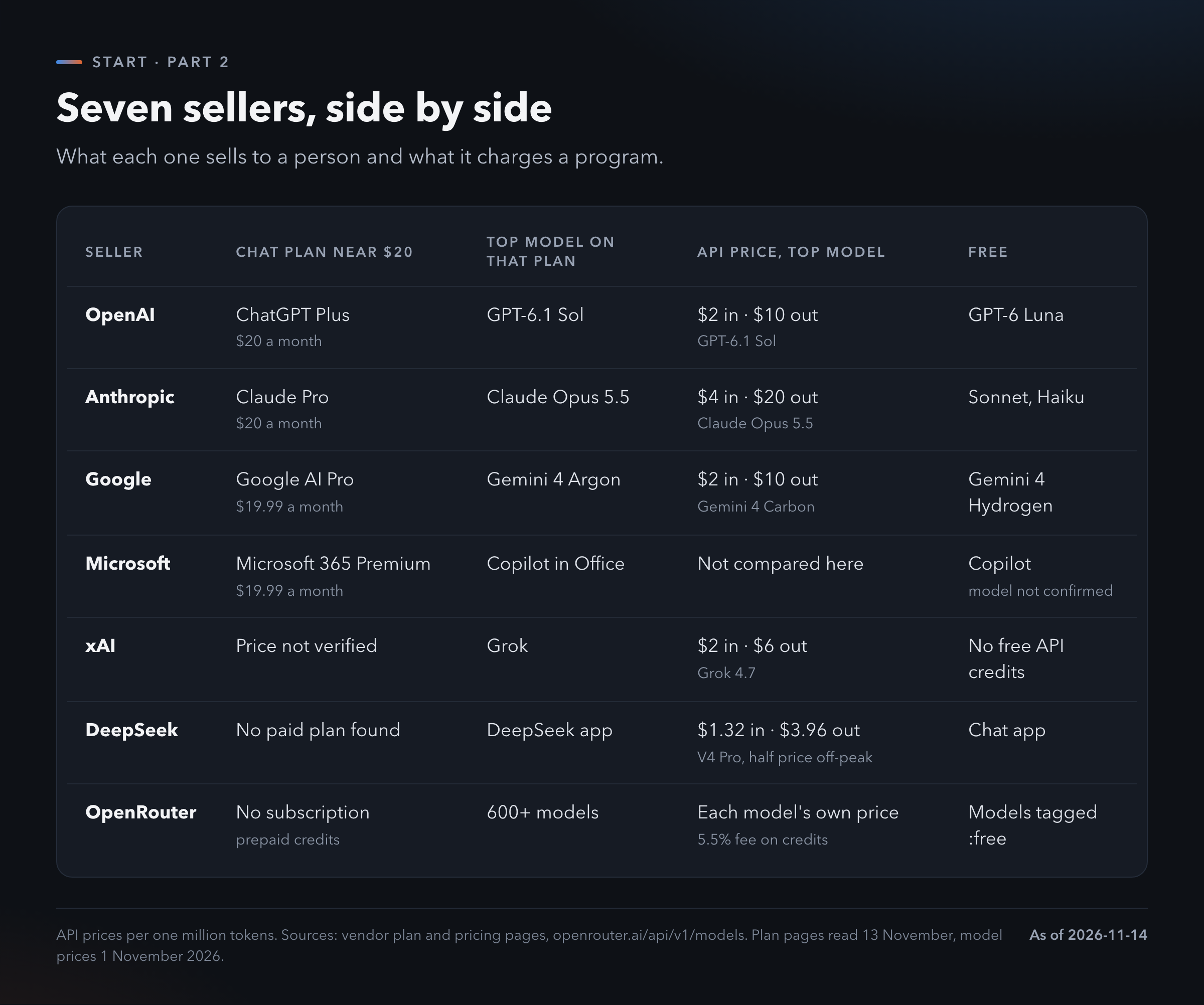
OpenAI. Makes ChatGPT. The free plan runs GPT-6 Luna. Plus costs $20 a month and adds GPT-6.1 Sol and Codex, the coding agent. There is a Go plan at $8 and Pro plans at $100, $200 and $500.
Anthropic. Makes Claude. The free plan runs Sonnet and Haiku. Pro costs $20 a month and adds Opus, Claude Code and Cowork. Max is $100 and Ultra is $200.
Google. Makes Gemini. The free plan gets Flash-Lite and Gemini 4 Hydrogen. AI Pro costs $19.99 a month and adds Gemini 4 Argon, four times the limits and Antigravity, its agent tool. Ultra starts at $99.99.
Microsoft. Sells Copilot inside Office. Microsoft 365 Premium costs $19.99 a month and includes what the plan page calls extensive Copilot use. GitHub Copilot is a separate product for code, with a free tier and paid tiers from $10.
xAI. Makes Grok. It has a chat app and an API that runs on prepaid credits. I could not verify its consumer plan prices from its own pages, so they are not here.
DeepSeek. A Chinese lab. It publishes its model weights and sells a very cheap API. It has a free chat app. I found no paid consumer plan.
OpenRouter. Builds no model. It gives you one key that reaches more than 600 models from more than 80 providers, on one bill.
2. What $20 buys
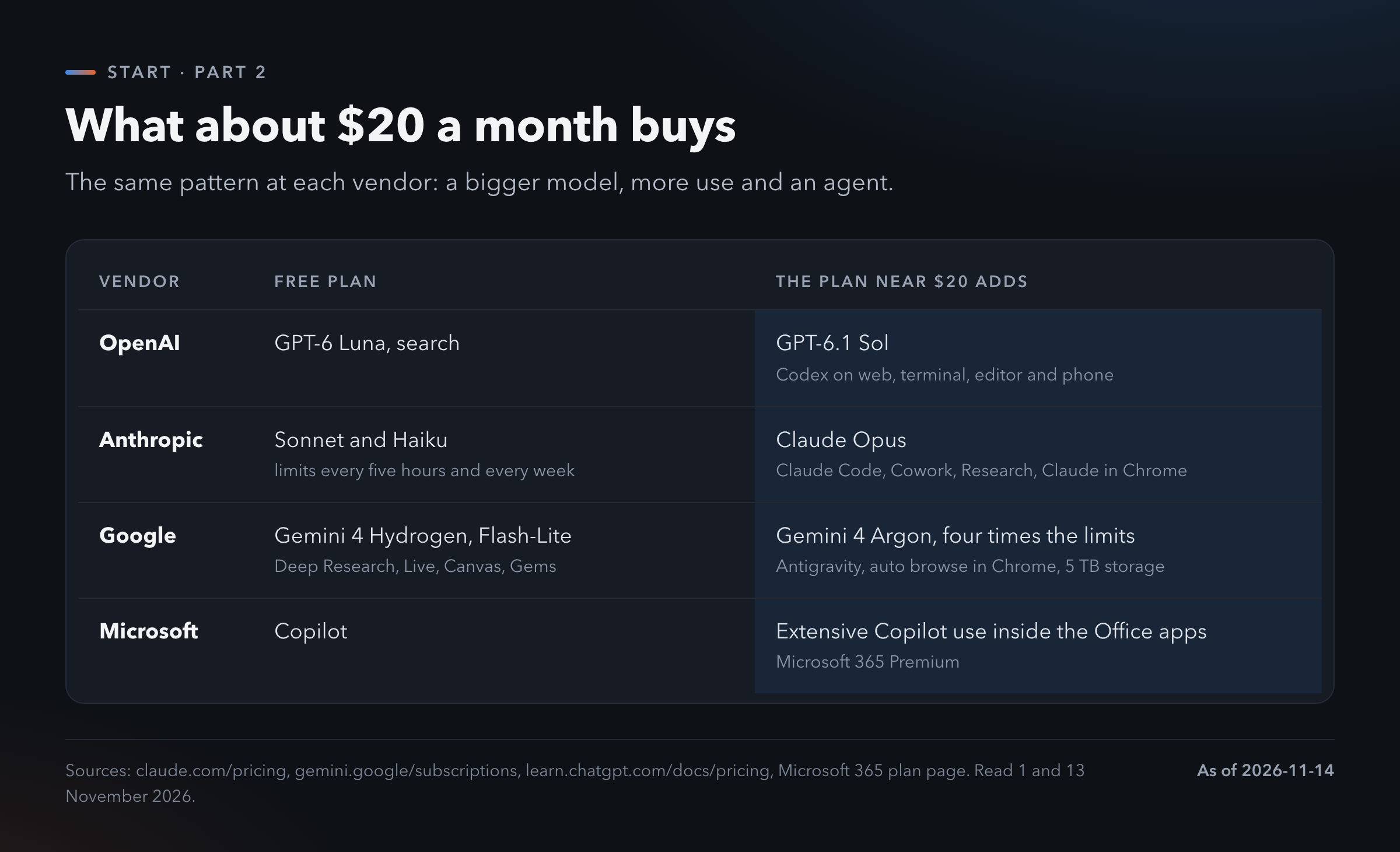
The pattern is the same at every vendor.
The $20 tier is where the big model and the agent show up.
Free gives you the small model and a ration. About $20 gives you the larger model, more use and a tool that can do work in steps.
Two cheaper plans look tempting. Read what they add.
ChatGPT Go costs $8. It raises the limits. The model stays Luna.
Google AI Plus costs $4.99. It doubles the limits. The Pro model starts one tier up.
Both buy you more of the small model. If the small model was the problem, more of it does not help.
The plans above $20 sell volume. $100 and up buys many times the usage of the $20 plan. You will know when you need that, because you will hit the limit every day. Start at $20.
One exception at the top. Anthropic's strongest model, Fable, is not part of the plain Pro allowance. Pro reaches it through usage credits.
3. Three ways to pay
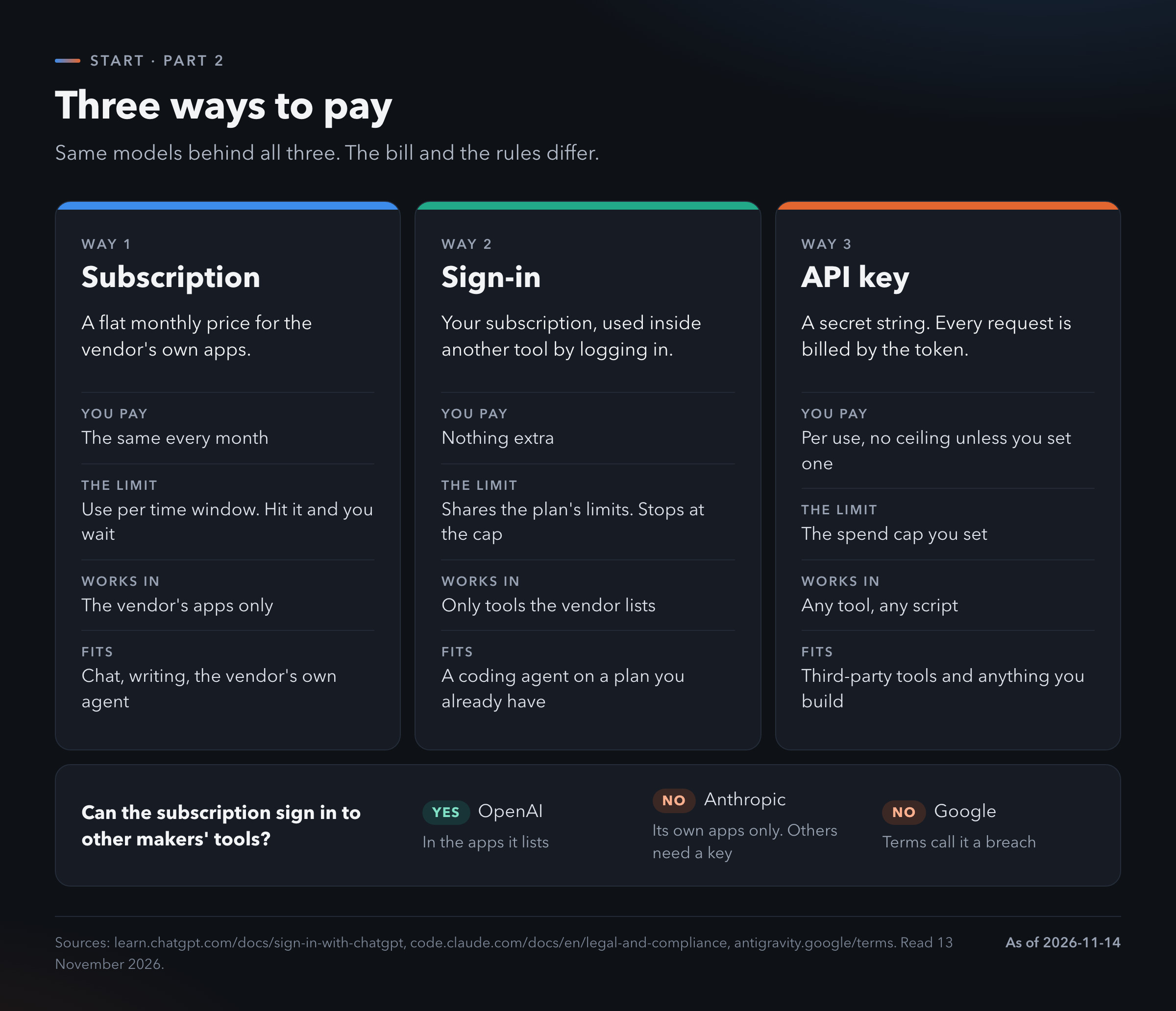
The same models sit behind three doors.
Subscription
A flat price every month. You use the vendor's own apps: the chat, the desktop app, its coding agent.
The limit is use per time window. Claude's free plan, for example, limits you every five hours and every week. Paid plans work the same way with a bigger allowance. Hit the limit and you wait.
You can never get a surprise bill. That is the whole appeal.
Sign-in
There are good tools made by other people. Coding agents, editors, terminals. They need a model behind them.
Sign-in means you log in to that tool with your subscription and the tool uses your plan. Nothing extra to pay.
Only one of the big three allows it.
OpenAI: yes. It calls this "Sign in with ChatGPT". It works in the apps OpenAI lists, Kilo Code, Warp, OpenCode and Devin among them [2]. Use counts toward your plan's limits. When you hit the cap it stops. It does not switch to paid billing behind your back.
Anthropic: no. A Claude subscription signs in to Claude Code and Anthropic's own apps. Other tools need an API key [2].
Google: no. The Antigravity terms call third-party access a breach and say the account may be suspended [2].
Never paste your subscription login or its token into a tool the vendor does not list.
Some tools offer to do it anyway. The risk sits with your account.
API key
An API is the door programs use. A key is a long secret string that opens it. Any tool that holds your key can use the model on your account.
You pay per token. A token is a chunk of a word, about three quarters of one in English. A million tokens is roughly 750,000 words. Several thick books.
Prices are quoted per million tokens, in and out. Input is what the model reads. Output is what it writes. Output costs more.
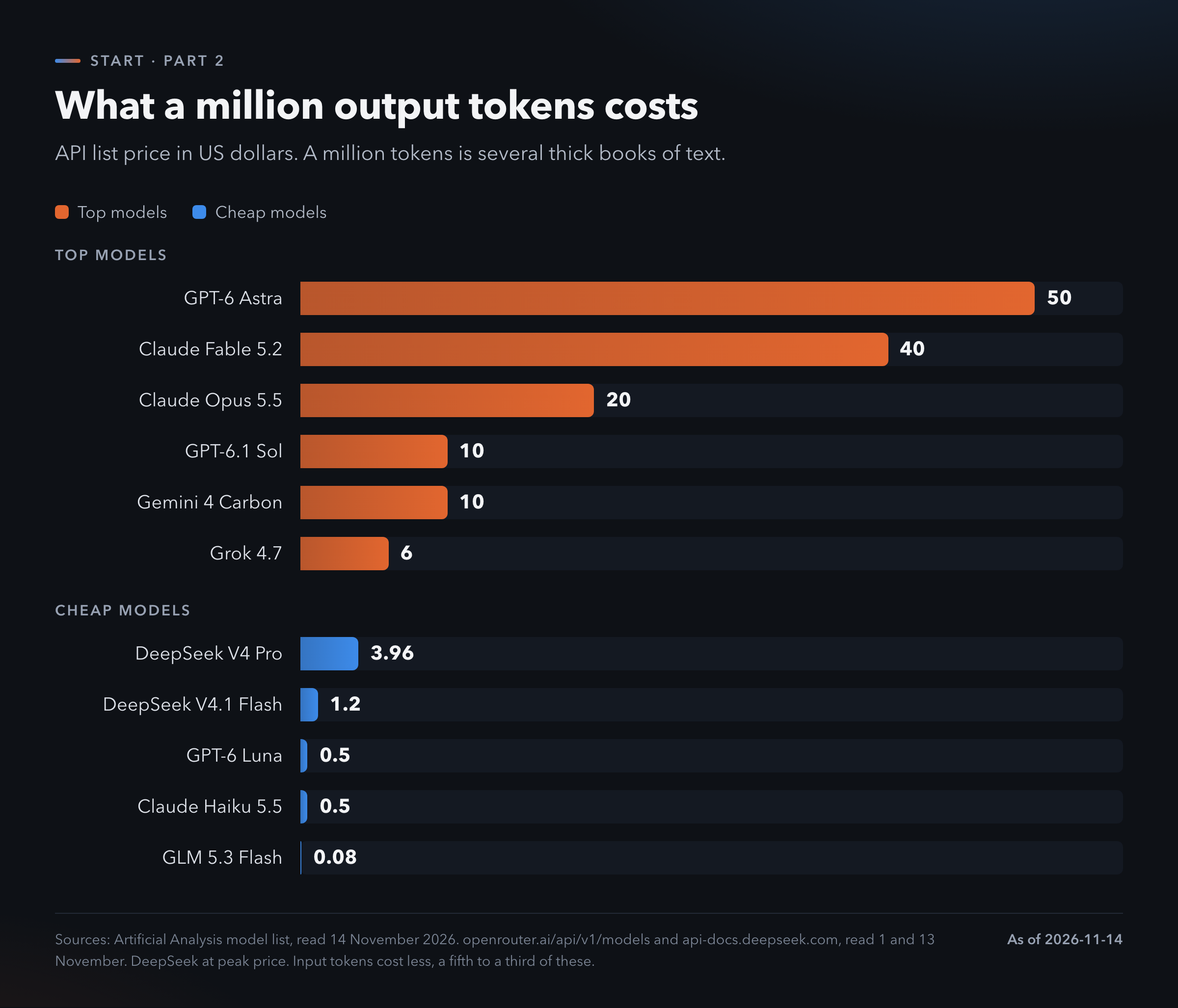
Look at the spread. A million output tokens costs $20 on Claude Opus 5.5 and $0.50 on Claude Haiku 5.5. Same vendor, forty times apart.
A key has no monthly ceiling unless you set one. An agent in a loop reads a lot and writes a lot. This is where surprise bills come from.
Three rules before the first call.
Set a cap first. Anthropic lets you set your own spend limit below the account maximum. Usage pauses when you reach it [4]. OpenRouter lets you cap each key, with a daily, weekly or monthly reset [5]. Where credits are prepaid, the amount you load is the cap. Load a small amount.
Keep the key out of sight. Never in code you share. Never in a chat. Never in a screenshot. Anyone who has the key spends your money.
One key per tool. If a tool misbehaves you delete one key and everything else keeps working.
4. Free tiers outside the chat
There is free access beyond the chat window. It is good for learning. It is not private.
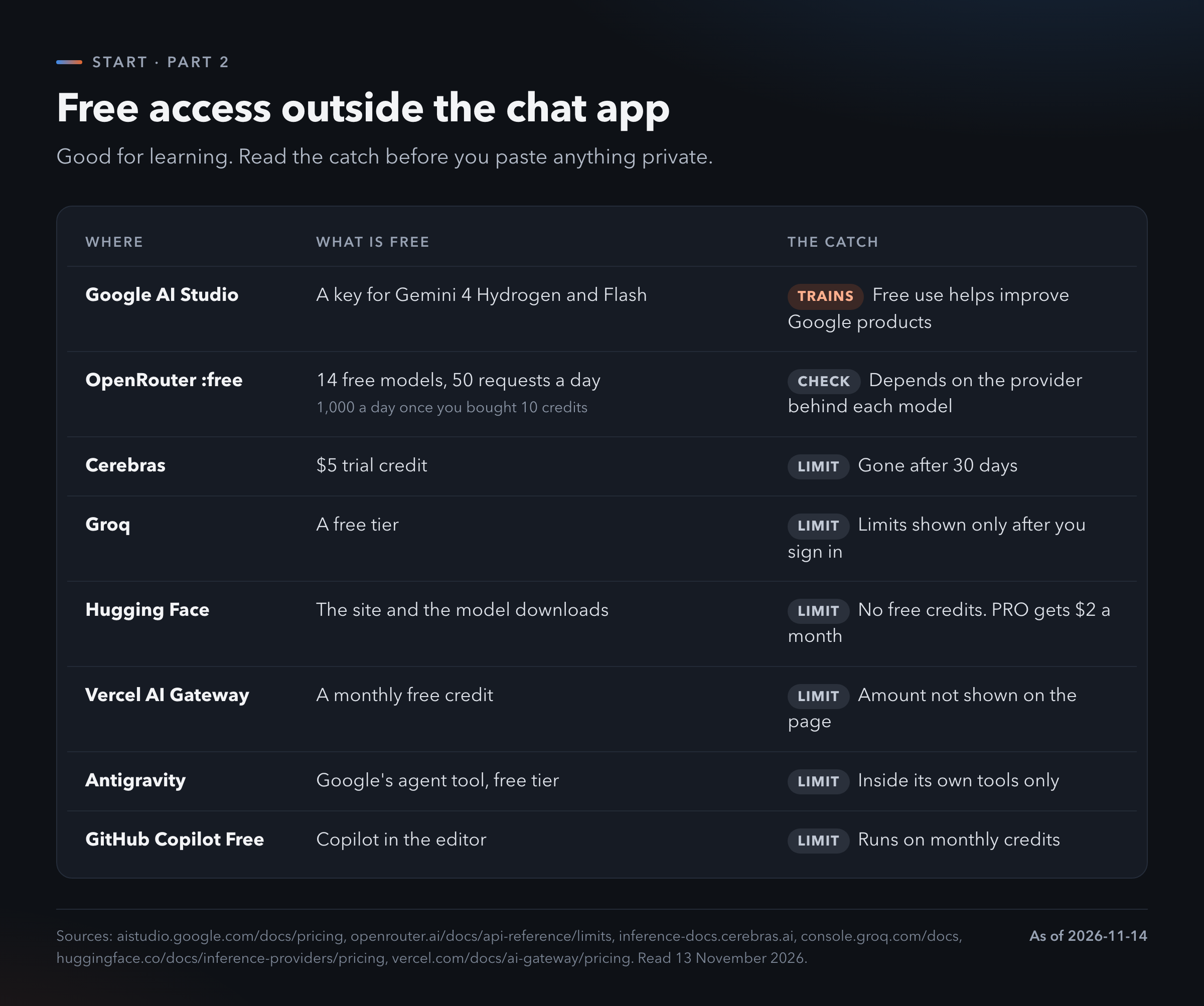
Google AI Studio gives you a free key for Gemini 4 Hydrogen and the Flash models. Its pricing page says free-tier content is used to improve Google's products [6].
OpenRouter tags some models :free. You get 50 requests a day, or 1,000 a day once you have bought 10 credits [5].
Cerebras gives a $5 trial credit that expires in 30 days. Groq has a free plan and shows its limits only after you sign in.
A free API tier often pays for itself with your prompts.
So the rule is short. Nothing private on a free tier. No client data, no contracts, nothing about another person.
5. OpenRouter in short
OpenRouter is a reseller. You buy credits once and one key reaches models from OpenAI, Anthropic, Google, xAI, DeepSeek and many open-weight labs.
What you get:
- One bill and one key for everything.
- Fallbacks. If one provider is down the request goes to another.
- A spend cap per key.
- An easy way to try a model before you commit to its vendor.
What it costs:
- A 5.5% fee when you buy credits [5]. Each model keeps its own price.
- One more company in the path of your prompts. By default it does not store them. The logging and training settings start switched off [5]. Check them anyway.
It sells no chat subscription. It is a key, so the three rules above apply.
Part 4 goes through it step by step, together with the open-weight models it is most useful for.
6. How to read a benchmark
Model names change every few months. The way to read a ranking does not.
Three questions, every time.
Who ran it? A vendor testing its own model is an advert. An outside lab running the same test on everyone is evidence.
What does it measure? Hard exam questions, coding tasks and which answer people prefer are three different things. No single number covers all of them.
What is the date? A ranking from the spring is history.
Here is one worked example. Artificial Analysis runs its own tests on every model and blends them into one score, the Intelligence Index [7]. This is the top ten as I read it on 14 November 2026.
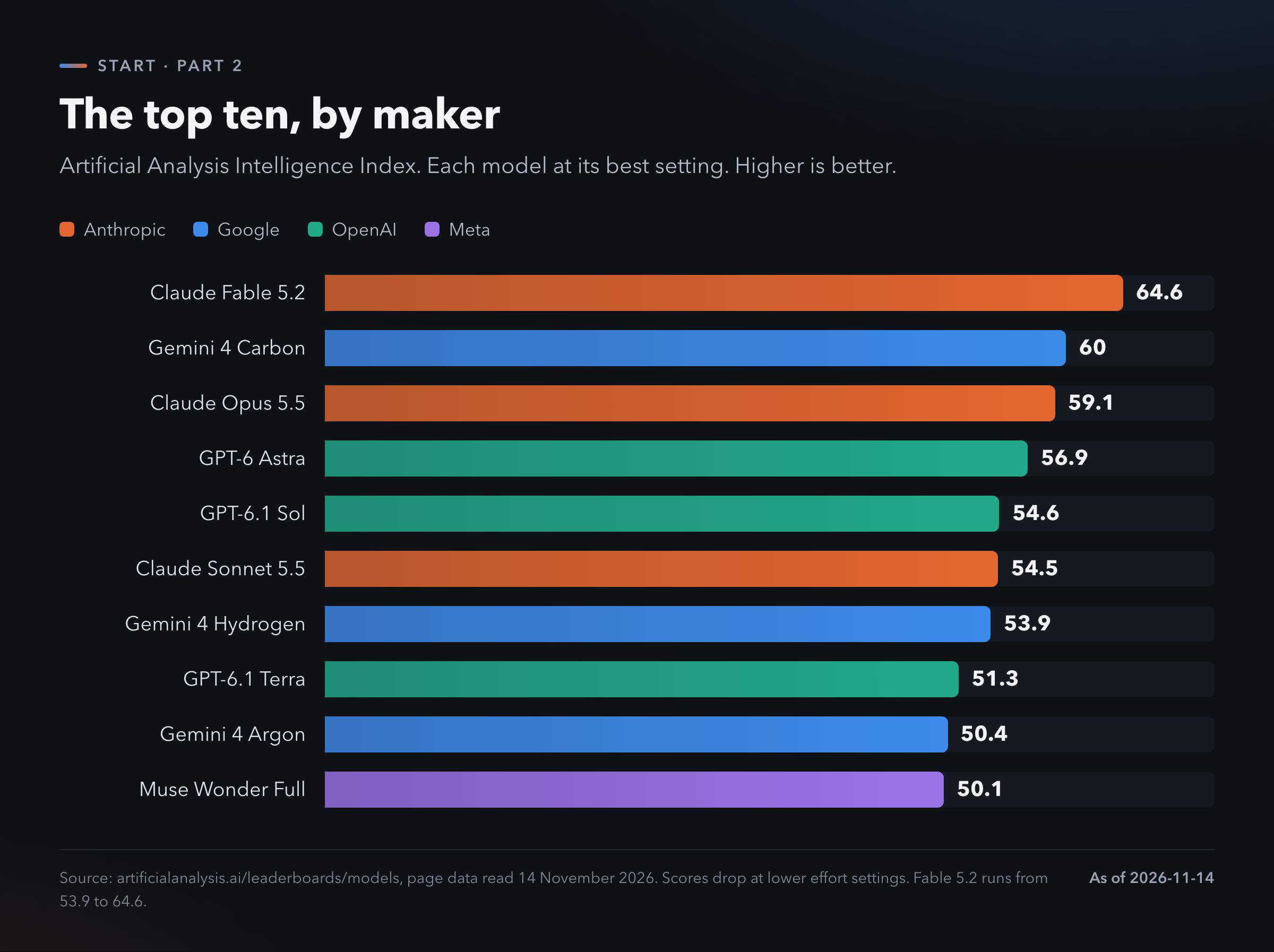
A few things to take from it.
Three makers hold nine of the ten places. Anthropic, Google and OpenAI. Meta takes the tenth.
The $20 models are all in it. Claude Opus 5.5 scores 59.1, GPT-6.1 Sol 54.6 and Gemini 4 Argon 50.4.
The first place costs more than $20. Claude Fable 5.2 leads at 64.6. Its API price is $40 per million output tokens. On Pro you reach it through usage credits.
Cheap models sit lower. Grok 4.7 scores 35.5 and DeepSeek V4.1 Flash 32.6. Neither is in the top ten. DeepSeek's Flash costs $1.20 per million output tokens against Fable's $40. For a lot of everyday work, that trade is a good one.
The setting matters as much as the name. Fable scores 53.9 on its lowest effort setting and 64.6 on its highest. Same model, eleven points apart. Gemini 4 Hydrogen, the model on Google's free plan, scores 53.9 at its top setting. The free app may not run it there.
That last point is the limit of every benchmark. It tests the model at a setting. You use an app. The app picks the setting.
One more board is worth a look. Arena asks people to compare two anonymous answers and vote. It measures which answer people prefer, which is not the same as which one is right. On 27 October 2026 its text board put Gemini 4 Carbon first at 1528, ahead of Gemini 4 Argon at 1520 and Claude Opus 5.5 at 1509 [8].
Two boards, two different leaders. Both are honest. They measure different things.
7. Which one fits
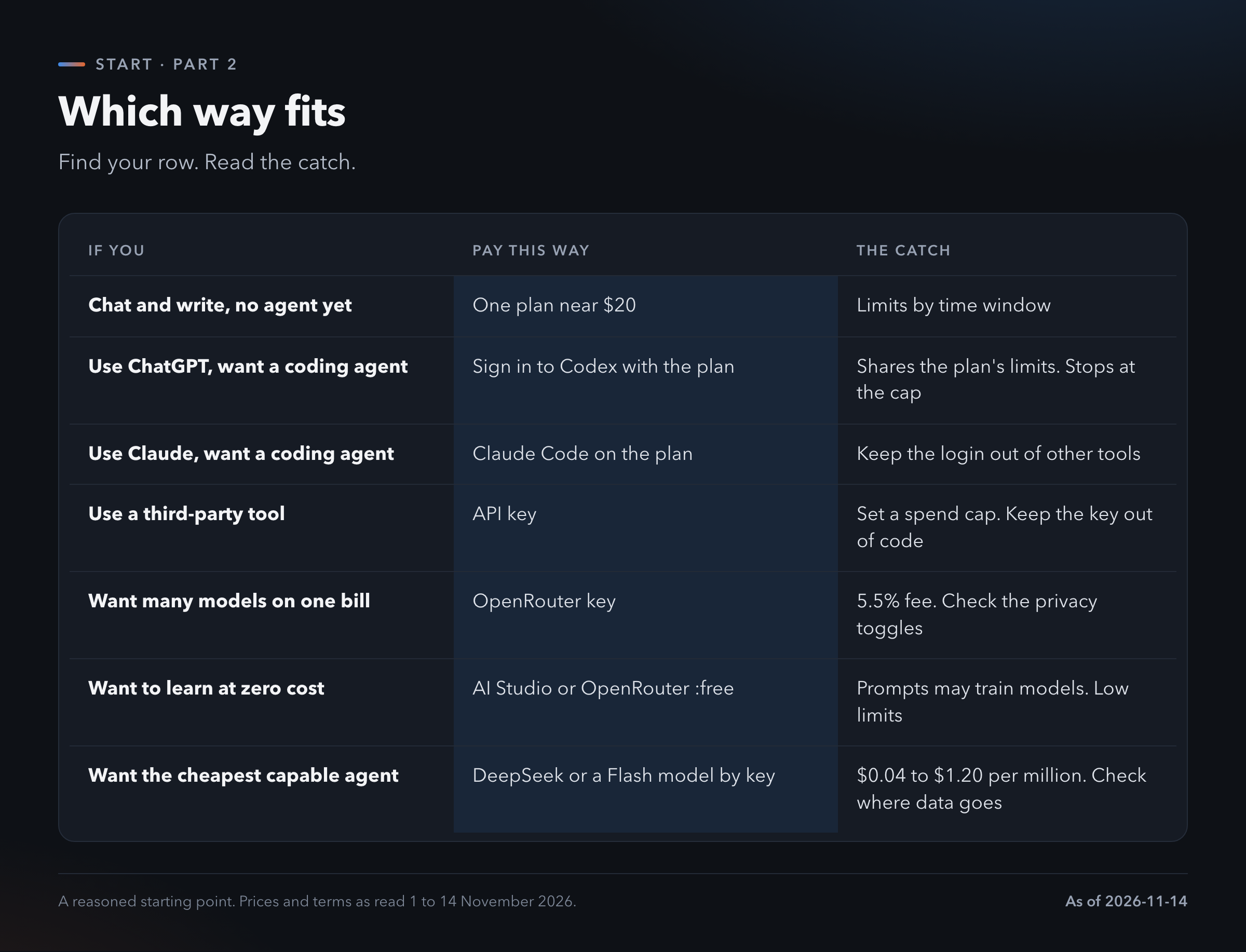
Find your row.
If you chat and write, one plan near $20 is enough. Pick the vendor whose app you already like. The difference between the three big ones is smaller than the difference between free and paid.
If you want a coding agent, use the one that comes with your plan. Codex on ChatGPT Plus. Claude Code on Claude Pro. Antigravity on Google AI Pro.
If you want a tool made by someone else, check the vendor's list first. If the tool is not on it, use an API key with a cap.
If you want to try many models, one OpenRouter key is simpler than five accounts.
If cost matters most, a cheap model by key goes a long way. DeepSeek's privacy policy says it stores data in China and may use it to improve its models, with an opt-out [9]. Read where your data goes before you send any.
8. Where I would start
One subscription near $20. One vendor. Stay a month.
Use the agent that comes with it before you look at any other tool.
When you want a tool the plan does not cover, make one API key. Set the cap before the first call. Load ten dollars, not a hundred.
Keep the free tiers for experiments with nothing private in them.
That's it. One plan and one capped key reach nearly everything in this article.
What I am probably getting wrong. I could not verify xAI's consumer prices, the model behind the free Copilot or the limits of DeepSeek's app, so those are missing. I did not check GitHub Copilot's terms on third-party tools. The sign-in rules come from each vendor's own documents as I read them on 13 November 2026 and vendors change them without notice. The benchmark section leans on one index and one preference board. Mistral and several other labs are not here at all. Check the plan page before you pay.
Three ways to pay for the same models.
The subscription can't surprise you.
The key can, so cap it first.
TL;DR
- Seven sellers: OpenAI, Anthropic, Google, Microsoft, xAI and DeepSeek build models. OpenRouter resells them all through one key.
- About $20 a month is where the bigger model and the agent appear. The $8 and $4.99 plans raise limits on the small model.
- Three ways to pay: a subscription with a flat price, sign-in to another tool with that subscription, or an API key billed per token.
- OpenAI allows sign-in to the tools it lists. Anthropic and Google do not. Never paste a subscription login into an unlisted tool.
- An API key has no ceiling unless you set one. Cap it, hide it, use one key per tool.
- Free API tiers often use your prompts. Nothing private goes there.
- Read any ranking with three questions: who ran it, what it measures and the date.
Help me pick a plan
Copy this into any chat with search turned on. It asks, checks today's prices and gives you one answer.
Help me decide how to pay for AI.

Ask me these one at a time:
1. What do I want to do: chat and write, code,
   automate tasks, or build something?
2. Which apps do I already use every day?
3. Do I handle private or client data?
4. What is my monthly budget?
5. Do I want one specific third-party tool? Which?

Then search the current plan and pricing pages for
OpenAI, Anthropic, Google, Microsoft, xAI, DeepSeek
and OpenRouter. Give me the date you checked each.

Recommend one of: a subscription, sign-in with a
subscription, or an API key. Name the plan and the
price. Tell me:
- the limit I will hit first
- whether my plan may be used in the tool I named,
  with a link to the vendor page that says so
- if you suggest an API key, the exact steps to set
  a spend cap before my first call
- what happens to my data, with a link

If you cannot verify something, say so. Do not guess
a price.
Where to go next
- Part 1. From Free Chat to Agents. Why the free chat lets you down and the five steps that fix most of it.
- Part 3. Harness. Why the same model gives a different result. The tools that make the difference.
- Part 4. Open. Open-weight models, Hugging Face and OpenRouter step by step.
- Part 5. Specialist. The models that are not chat: image, speech, music, 3D, documents.
- Part 6. Local. Running models on your own machine.
To see the latest model rankings yourself: Artificial Analysis (artificialanalysis.ai) and Arena, formerly LMArena (arena.ai/leaderboard).
References
[1] Plan pages, read 1 and 13 November 2026: https://learn.chatgpt.com/docs/pricing, https://claude.com/pricing, https://gemini.google/subscriptions
[2] Sign-in rules, read 13 November 2026: https://learn.chatgpt.com/docs/sign-in-with-chatgpt, https://code.claude.com/docs/en/legal-and-compliance, https://antigravity.google/terms
[3] API prices, read 1 and 13 November 2026: vendor pricing pages, https://docs.x.ai/developers/models, https://api-docs.deepseek.com/quick_start/pricing, https://openrouter.ai/api/v1/models
[4] Anthropic, API rate limits and spend limits, read 14 November 2026. https://platform.claude.com/docs/en/api/rate-limits
[5] OpenRouter, read 13 November 2026: https://openrouter.ai/pricing, https://openrouter.ai/docs/api-reference/limits, https://openrouter.ai/docs/guides/privacy/data-collection
[6] Free tiers, read 13 November 2026: https://aistudio.google.com/docs/pricing, https://inference-docs.cerebras.ai/support/rate-limits, https://console.groq.com/docs/rate-limits, https://huggingface.co/docs/inference-providers/pricing, https://vercel.com/docs/ai-gateway/pricing
[7] Artificial Analysis, Intelligence Index, read 14 November 2026. https://artificialanalysis.ai/leaderboards/models
[8] Arena, text leaderboard, read 27 October 2026. https://arena.ai/leaderboard
[9] DeepSeek privacy policy, read 13 November 2026. https://cdn.deepseek.com/policies/en-US/deepseek-privacy-policy.html